

GPU clusters
A GPU cluster is a group of interconnected servers, each equipped with multiple high-performance GPUs. Clusters run workloads that require massive parallel processing: training large language models (LLMs), fine-tuning foundation models, running inference at scale, and high-performance computing (HPC).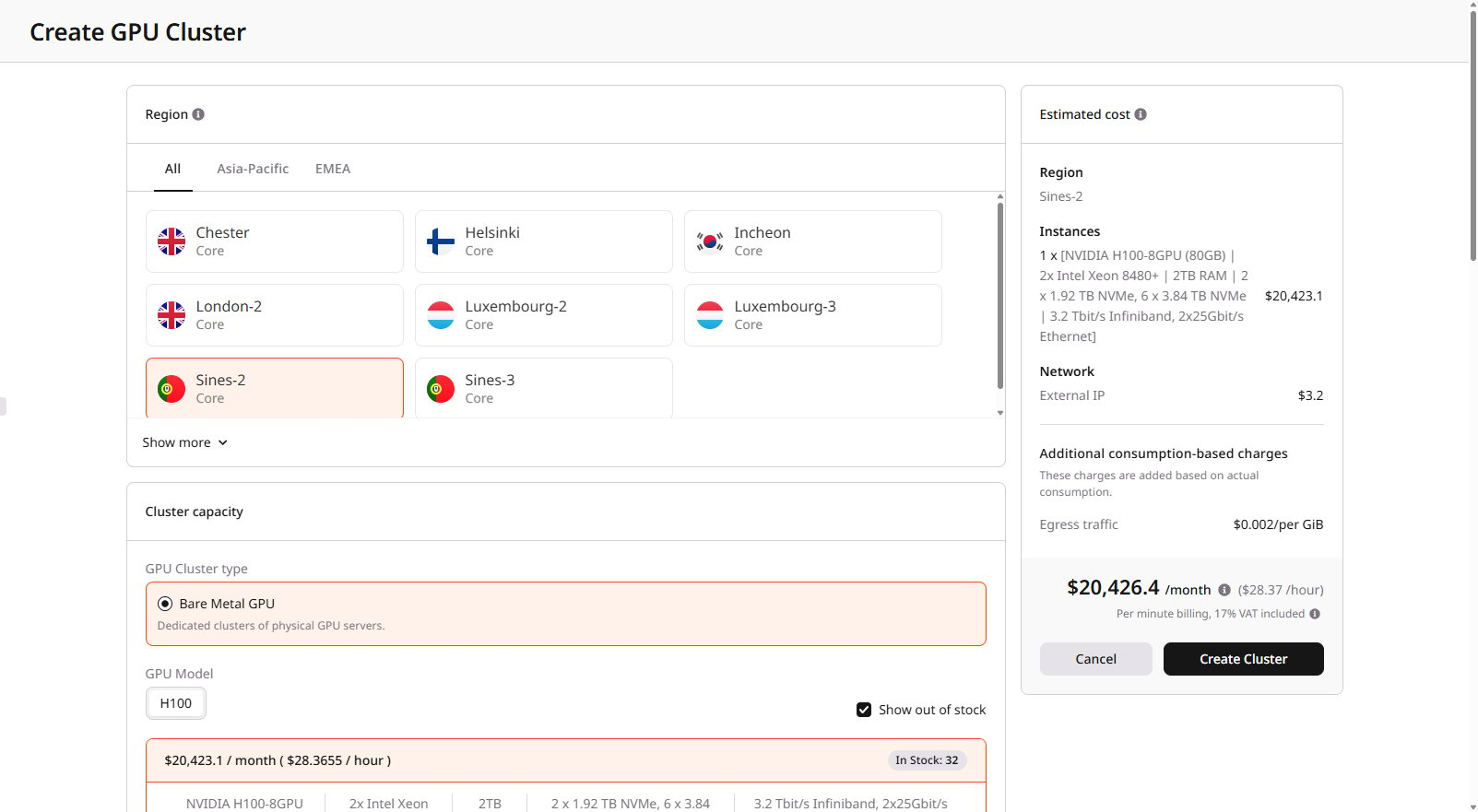
Cluster types
Gcore offers three types of GPU clusters:
Clusters can scale to hundreds of nodes. Production deployments with 250+ nodes in a single cluster are supported, limited only by regional stock availability.
Available configurations
Select a configuration based on workload requirements:
Outbound data transfer (egress) from GPU clusters is free. Other costs are covered in GPU Cloud billing.
Configurations with InfiniBand are configured automatically at cluster creation — all nodes join the same InfiniBand domain with no manual setup required.
Storage options
GPU clusters support two storage types:Cluster lifecycle
- Create: Select region, GPU type, number of nodes, image, and network settings. Create a Bare Metal GPU cluster or a Virtual GPU cluster.
- Configure: Connect via SSH to each node, install required dependencies, and mount file shares to prepare the environment for workloads.
- Run workloads: Execute training jobs, run inference services, process data.
- Resize: Add or remove nodes on demand — new nodes inherit the cluster configuration.
- Delete: Remove the cluster when no longer needed. Local storage is erased; file shares and network disks can be preserved.
GPU cluster characteristics
- Provisioning takes 15–40 minutes
- The configuration (image, network, and storage) is fixed at creation and cannot be changed afterward
- Local NVMe storage is temporary — store critical data in persistent file shares
- Spot clusters can be interrupted with a 24-hour notice
- Available regional capacity determines cluster size
- Servers equipped with BlueField network cards support hardware firewalls
- Use a single GPU server for development or smaller workloads; use a cluster for large models, distributed training, or high-scale inference
nvidia-smi to confirm GPU availability and ibstat to verify InfiniBand connectivity.